Anna Nagar, Madurai – 625020, Tamil Nadu

Organisation Profile & Governance

Registered in 1996 (Reg. No. 29 / BK.4 / 96), Annai Theresa Rural Development Trust (ATRDT) works under the motto "Secular Service to Humane – மதச் சார்பற்ற மனிதநேயம்" across Madurai District.

Official Organisation Profile

Grassroots Commitment to Social Equity Since 1996

Annai Theresa Rural Development Trust (ATRDT) is a secular voluntary social service organisation established in 1996 in Madurai, Tamil Nadu. Guided by the Gandhian ideal of an equitable, humanitarian, and democratic society, the Trust focuses on uplifting sanitation workers' families (predominantly the Arunthathiar community, comprising nearly 98% of this occupational group in Madurai) and the rural poor.

Through education, vocational skill building, preventive medical camps, civic sanitation management, and participatory research, ATRDT empowers women, children, and disadvantaged households to manage positive change in their own lives.

Primary Focus

Sanitation Workers' Families

Educational, economic & occupational upliftment across Madurai District.

Core Principle

Secular Humanism

Relief and development irrespective of caste, creed, or religion.
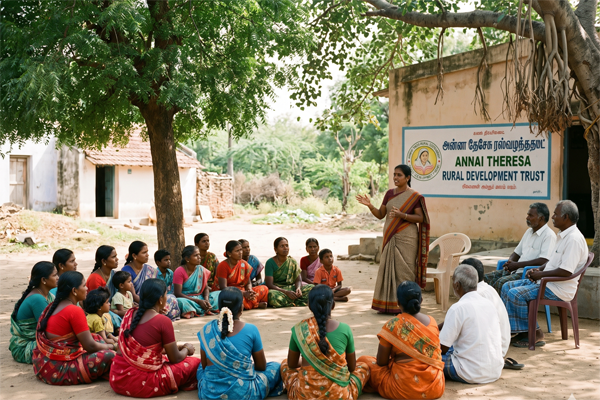
Community education and empowerment in Tamil Nadu
Secular Service to Humane

மதச் சார்பற்ற மனிதநேயம்

Supporting education, health, women's self-reliance, and dignified livelihoods in Madurai.

Guiding Purpose

Our Vision

ATRDT TRUST envisions an “equitable, humanitarian, democratic, economic and social well being” as visualised by Mahatma Gandhi, The Father of Our nation.

Core Mandate

Our Mission

Contributing towards the promotion of sanitation workers and rural people through education, appropriate training, research, and medical services for better development, unity and cooperation among the people, and to empower and develop the capacity of sanitation worker and rural families—particularly women and children—through enabling them to manage the changes they seek in their own lives.
Section C • Institutional Leadership

Governing Body & Board of Trustees

Official governance structure as recorded in the ATRDT Organisation Profile:

1. Governing Body

S.No Name Designation / Role Profession Experience
1 Mr. G. Jayaraj Managing Trustee Social Worker 30 Years
2 Mrs. M. Saroja Financial Trustee

Social Worker

30 Years

2. Board of Trustees

S.No Name Designation / Role Profession Experience
1 Mr. G. Jayaraj Managing Trustee Social Worker 30 Years
2 Mrs. M. Saroja Financial Trustee

Social Worker

30 Years
3 R. Jayalakshmi Trustee Social Worker 11 years
4 K.Anusiyadevi Trustee Social Worker 11 years
Section E • Trust Deed Mandate

Complete Objectives of ATRDT

All 22 foundational objectives enshrined in the Annai Theresa Rural Development Trust charter—spanning education, preventive health, vocational rehabilitation, disaster relief, elderly & disability care, environmental conservation, and participatory action research.

Objective 01

To provide and facilitate education for children from sanitation workers' and rural poor communities.

Objective 02

To raise and improve the health status of sanitation workers, rural communities, and disabled persons by providing curative and preventive health services.

Objective 03

To establish vocational training centres for sanitation workers and the rural poor to generate income, build confidence, and facilitate rehabilitation programmes.

Objective 04

To work and develop need-based assistance for the economic rehabilitation of sanitation workers and rural poor communities.

Objective 05

To improve the economic, social, and cultural status of sanitation workers and rural communities and enhance their skills and self-management capacity.

Objective 06

To establish collaboration with welfare agencies, banks, and government departments for community upliftment.

Objective 07

To undertake social service activities and provide facilities for the relief of the poor irrespective of caste, creed, or religion.

Objective 08

To organise and run child-to-child programmes, nursery, primary, and secondary schooling continuously.

Objective 09

To develop rural development activities as integrated socio-economic and cultural development programmes.

Objective 10

To conduct awareness generation programmes in personal hygiene, health and sanitation, food and nutrition, government welfare schemes, small savings, agriculture, animal husbandry, and cottage industries.

Objective 11

To conduct seminars/workshops and arrange special tuition and coaching for students in government schools in villages.

Objective 12

To establish, promote, set up, run, and maintain educational institutions such as residential schools, colleges, and research centres.

Objective 13

To run educational institutions and study/research centres for spreading education to the general public without any profit motive.

Objective 14

To provide food, medical, and monetary relief for persons and animals affected by natural and other calamities such as floods, fire, cyclones, earthquakes, droughts, and epidemics.

Objective 15

To render assistance to intellectually and physically challenged children through therapy, special education, and vocational rehabilitation.

Objective 16

To open and support care homes and institutions to rehabilitate orphans, destitute, and distressed individuals.

Objective 17

To establish and assist senior citizen homes for deserted older persons, engaging them in environmental development such as tree plantation.

Objective 18

To conduct awareness generation programmes in herbal plantation and medicinal flora.

Objective 19

To establish, run, and aid free public reading rooms and community libraries.

Objective 20

To undertake research studies on development issues and socio-economic surveys for learning, sharing, and action.

Objective 21

To undertake feasibility studies, programme/project evaluations, and sustainability and impact assessments for development agencies.

Objective 22

To evolve alternative development models through Participatory Action Research addressing the girl child, child labour, women in difficult circumstances, environment, sustainable agriculture, biodiversity, disability welfare, and widows.